
Following the death of Ayatollah Ali Khamenei, his son and successor, Mojtaba Khamenei, issued a "revenge list" featuring 13 world leaders, including Donald Trump and Benjamin Netanyahu, with a graphic depicting them as targets, amidst escalating regional hostilities and US reports of an Iranian assassination plot against Trump.

The Beijing summit may have reduced immediate diplomatic uncertainty, but it did not resolve the deeper structural contest between the United States and China. That contest appears likely to define the coming decade, notes Varun Arya.
India may press for an automatic review mechanism in its proposed interim trade deal with the United States (US), mirroring a sunset clause introduced by the European Parliament in its trade agreement with Washington, people aware of the negotiations said. The European Parliament last week approved the EU-US trade deal but inserted a sunset clause requiring the arrangement to expire on December 31, 2029, unless both sides agree to extend it.
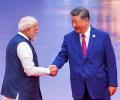
India's dual pursuit of a robust strategic partnership with Washington and a pragmatic, tension-management policy with Beijing represents the essence of modern multi-alignment. By embracing economic pragmatism, learning to compartmentalize political differences, and engaging in continuous dialogue, India can secure its borders, grow its economy, and contribute to a stable, multipolar Asian century, points out Ambassador Rajasekhar.

By all available indications, the White House drafted a face-saving note and handed it, ready-made, to Islamabad. Pakistani Prime Minister Shehbaz Sharif was supposed to then post it in the guise of a plea urging Trump to extend the deadline by two weeks 'to allow diplomacy to run its course'. Trump would then graciously accept Pakistan's 'request' and declare a ceasefire. Sharif dutifully posted the message on X. Except that he, or whoever was handling the account, forgot to delete the tell-tale first line visible in the edit history: 'Draft - Pakistan's PM Message on X'. Prem Panicker's must read blog on the Iran War.

US President Donald Trump has lauded India as an 'essential partner' and 'trusted ally' in addressing regional challenges, particularly its 'big role' in West Asia peace efforts, following discussions with Prime Minister Narendra Modi at the G7 Summit.

As Tehran and Washington continue with their engagements following the signing of the MoU earlier this month, sources have told Al Arabiya that the two are set to hold the next round of negotiations in Switzerland on June 28 and 29.

President Barack Obama is looking forward to a Summit with Prime Minister Narendra Modi in September to set an "ambitious new agenda" to chart a new course in the bilateral ties, top United States functionaries US Secretary of State John Kerry and Secretary of Commerce Penny Pritzker said on Friday.

Much will depend on how the protagonists use the current interlude to work proactively for the beginning of a durable settlement or, on the contrary, prepare for a new round of escalation, points out Ambassador M K Bhadrakumar.

'Actual implementation of the 14-point agreement is proving hard to achieve let alone striking and sustaining a long-term treaty or deal.'

US President Donald Trump lauded Prime Minister Narendra Modi's 'calm, cool, killer' persona at the G7 leaders' lunch in France, underscoring the deeply strategic relationship and formidable diplomatic skills of the Indian leader ahead of their crucial bilateral meeting.

Ebrahim Azizi, Head of the Iranian Parliament's National Security Committee, warned the US against interfering with the Strait of Hormuz, asserting Iran's sovereignty after former President Donald Trump threatened to 'take over' the strategic waterway. Despite the heated rhetoric, Iran and the US have established a direct communication line to prevent incidents during a 60-day negotiation period.

The United States and India are on the verge of finalising a landmark bilateral trade deal, aiming to boost trade to USD 500 billion by 2030, according to US Deputy Assistant Secretary of State Bethany Poulos Morrison. The agreement seeks to open India's 1.4 billion-strong market to American goods on reciprocal terms, with ongoing high-level discussions to recalibrate the pact after recent changes in US tariff policy.

India too can rise to the top if the 1.4 billion Indians back home are given better opportunities to use their innate talent and capacity to work hard, with right incentives in a more meritocratic rules-based system, asserts Ajay Chhibber.

The harsh truth is that the US is no longer a reliable partner, cautions Ramesh Menon.

The core issues to be settled -- access to Hormuz, Israel's aggression in Lebanon, the question of Iran's nuclear programme, sanctions relief and compensation -- are thorny enough to require weeks of patient negotiation. The most likely outcome of the opening sessions is that both sides take the measure of each other, establish what is and is not negotiable, and return home without having broken anything. That would count as progress.

A US-Iran memorandum of understanding is set to be signed, outlining sanctions relief, the reopening of the Strait of Hormuz, and a 60-day negotiation window for Iran's uranium enrichment, but US President Donald Trump has underscored the deal's conditional nature, warning of military action if Tehran fails to comply.

US Vice President JD Vance on Sunday generated significant online traction after making a light-hearted reference to two "very, very important" Indian and Pakistani people in his life - his wife Usha Vance and Pakistani Army chief Asim Munir, on the sidelines of the US-Iran diplomatic deliberations in Switzerland.

This sharp Iranian response came after a series of uncompromising remarks from the US president.

'The flip side of this is that he won't hesitate to call out India if he thinks its policies are hurting US economic interests or border US foreign policy goals.'

US President Donald Trump has sharply criticised Israeli Prime Minister Benjamin Netanyahu over the handling of military operations in Lebanon, expressing dissatisfaction with the pace of the conflict and the escalating civilian death toll.

US President Donald Trump and Chinese President Xi Jinping began a crucial two-day summit in Beijing on Thursday, with both leaders signalling a desire to stabilise relations between the world's two biggest economies despite deep disagreements on trade, Taiwan, technology and security issues.

US Secretary of War Pete Hegseth praised India's military modernisation efforts at the Shangri-La Dialogue in Singapore, highlighting its growing industrial and logistics capacity.
India and the United States have reviewed progress on a proposed interim bilateral trade agreement, discussing market access, digital trade, and non-tariff barriers, as they race to finalise a deal before a temporary 10 per cent US tariff regime expires on July 24.

Earlier, Israeli Prime Minister Benjamin Netanyahu also declared that Iran would never be allowed to acquire nuclear weapons, regardless of any agreement.

The economic fallout of the West Asia crisis, the prevailing security situation in the Indo-Pacific and ways to boost cooperation in critical minerals and technology are expected to top the agenda at a crucial meeting of the Quad foreign ministers on Tuesday.

Pakistan Prime Minister Shehbaz Sharif on Thursday signed the historic peace deal between the United States and Iran as a guarantor; the agreement will see the immediate reopening of the Strait of Hormuz and the lifting of the US naval blockade.

'They talked bad about our leaders. They said India was a dead economy. They were not sensitive to the Indian psyche.'

Tensions escalate between Iran and the US over control of the Strait of Hormuz, a crucial shipping lane for global oil supplies, as both sides discuss extending a fragile ceasefire.

US President Donald Trump will travel to China in May for a rescheduled summit with Chinese President Xi Jinping, following a postponement due to the war in Iran. The White House has announced the new dates and indicated a reciprocal visit to Washington DC is planned.

Chinese leaders, including its generals, will have to weigh whether they can win a war if they ever attack Taiwan and if at all, can they sustain the subsequent devastation, notes Rup Narayan Das.
Prem Panicker's Must Read Blog On The Gulf War.

Iran has denied sending a delegation to Islamabad for peace talks with the United States, contradicting Pakistan's claims of mediating the negotiations. The denial highlights a lack of confidence in Pakistan's ability to ensure security for high-level participants and underscores the fragile nature of diplomatic efforts between the US and Iran.

A new report suggests China's maritime vulnerability lies in the Strait of Hormuz, not Malacca, creating strategic competition in the Indian Ocean.

Donald Trump has issued a stern warning to Iran, stating that the US will take a tougher stance if a diplomatic resolution regarding its nuclear programme is not reached soon.

The US President had hosted Modi for an official working visit in Washington, DC, on February 13 last year.

China's Foreign Ministry has refuted allegations of providing military support to Iran, warning the US against imposing tariffs based on these accusations. The statement follows reports of Iran acquiring a Chinese satellite for targeting US military bases. Meanwhile, a rescheduled meeting between Presidents Trump and Xi Jinping is set for May.

US President Donald Trump received a red carpet welcome in Beijing for talks with Chinese President Xi Jinping on trade, the Iran war, and other key issues. The visit underscores the importance both nations place on their relationship amid ongoing tensions.

How the UN's flagship climate summit lost its direction and what's at stake.

Delhi must now purge the delusional hopes of being a 'counterweight' to China in the US calculus, argues Ambassador M K Bhadrakumar.
